


Thomas J Lytle was born in Indianapolis in December 1855. His parents were William Lytle and Caroline Lytle (Moorehead). Both parents were born in Ohio, as were Thomas’s sister Jane and brother John. Thomas’s sisters Mary and Esther were born in Indiana, as were the remaining children…Eliza; Sarah; and Clara. Thomas grew up on his father’s farm. By 1870, William was deceased, and Caroline Lytle was now living in Henry County, with Thomas (16); Sarah 13; and Clara (11). And it would seem that Thomas was working on the family farm, with his mother’s listed occupation being that of…cleaning house. In 1880, Thomas, 26 years-old now, was living in Mt. Pleasant, Iowa, at 8 Adam’s street. His occupation is listed as…farmer, but he was actually a boarder at the time. He would be known as a farmer/rancher for the rest of his life. He was divorced by 1920, and his son John was living with him. The 1915 state census indicates that he was of German-Irish descent and already divorced.
Thomas married Capitola Cobb on March 31, 1881 in Henry, Iowa, and the pair moved to South Dakota in 1883. In the same year, Thomas objected to taxes being assessed to him…
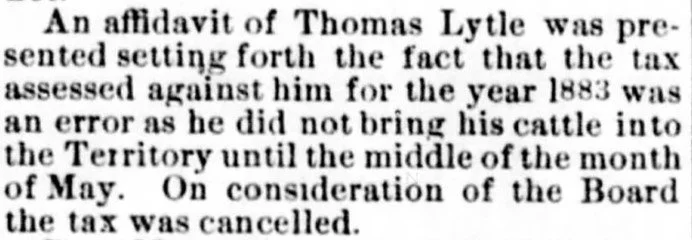
And so…Thomas won. In 1890, he decided to run for office…
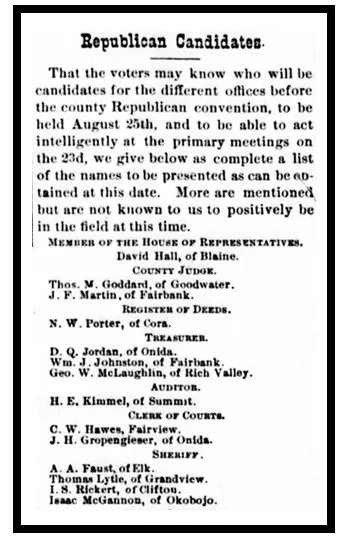
…as a Republican…for sheriff.
In 1894, he was accused fencing public property for personal use…
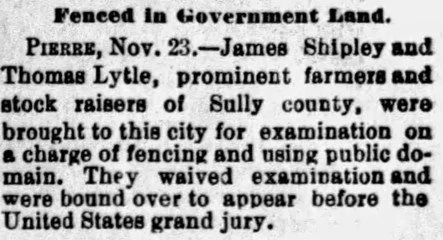
Personally, I think it was James Shipley’s fault. And 1895 witnessed a rather puzzling situation…
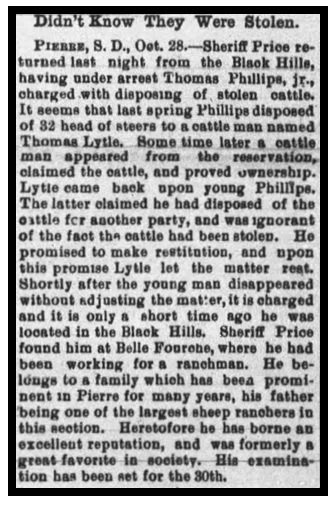
So, Phillips was a thief and conman. He stole cattle and sold it to Thomas. Phillips claimed that he didn’t know the cattle were stolen, and promised to rectify the situation. And oddly enough, Thomas believed the thief’s promise only to find, and what a surprise it is, that Phillips bolted.
Farm animal shenanigans…
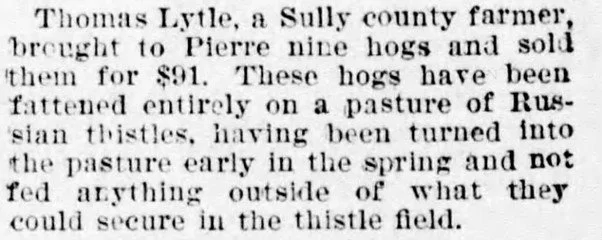
Isn’t Russian Thistle the same thing as tumbleweeds?

Can’t we eat slop like the other hogs?
It appears that Thomas was lacking in good character, leading to the divorce. According to Capitola, Thomas was a hard drinker who lived in …willful disregard to his marriage vows…and that he had been in the habit of frequenting houses of ill fame and consorting with lewd women, and keepers and inmates of houses of prostitution. According to Capitola, this behavior had started in roughly 1897. If that wasn’t bad enough, Capitola claimed that he had been abusive to her and used profane language around the children. Finally, he had no longer provide sufficient financial support to her. But this wasn’t in private…
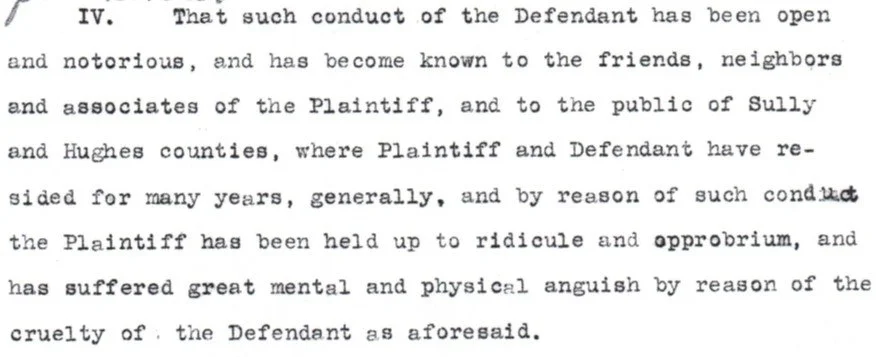
It’s hard to know just what set him off. Thomas admitted guilt in some of Capitola’s claims, but innocent of others. He also stated that Capitola had forgiven him, and that none of his bad behaviors were repeated after the reconciliation. Then he returned the accusations, directing some of them at Capitola…
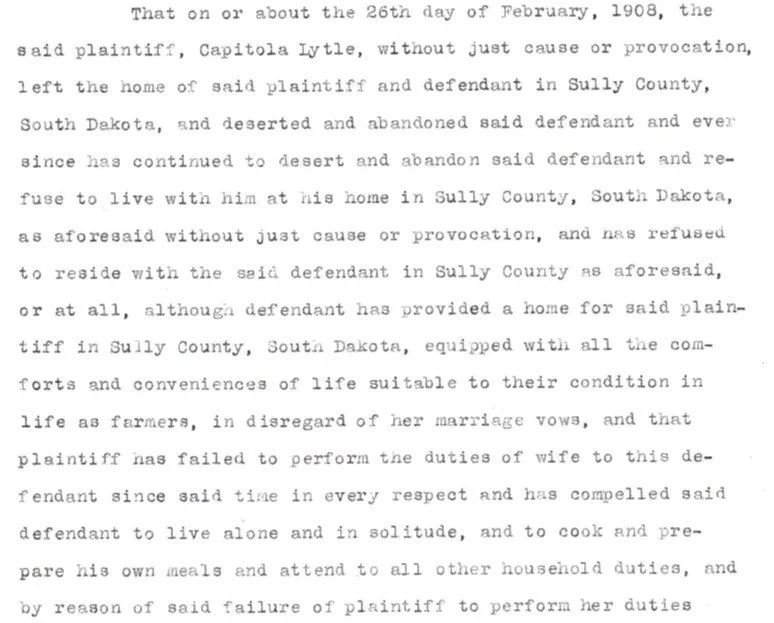
It’s interesting to note that Capitola and Thomas took a trip to the south, nonetheless, upon returning, Capitola is accused of being unwilling to live with him. The divorce was granted on November 2, 1912. And the family’s property, real and personal, were divided between them. Capitola received a home in Pierre, but other property was sold at auction, particularly to Mrs. Matilda Blake, who may be the Matilda Blake whom the 1935 state census lists as divorced.
Thomas and Capitola had three children…Frank Stewart (1889-1970); John Raymond (1887-1953); and Clara DeEtte (1885-1928).
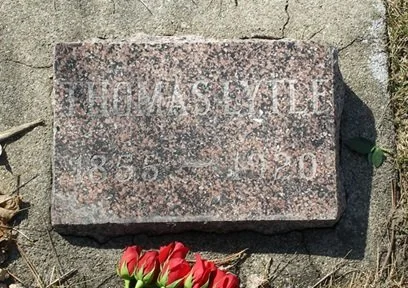
Thomas became ill with cancer in 1918, and died on November 27, 1920 at the Radium Hospital in Omaha, Nebraska. His body was returned to South Dakota for burial on November 26, 1920. He was buried in Woodlawn Cemetery in Sioux Falls, South Dakota, with his ex-wife, Capitola Lytle (Cobb) and daughter Clara DeEtte Hastings (Lytle).
Commodo cursus magna, vel scelerisque nisl consectetur et. Donec id elit non mi porta gravida at eget metus.